FreeWebCheck
IPv4 vs IPv6: What's the Difference?
I didn’t think much about IP versions until I noticed my IPv4 address was worth money. Not figuratively — a single IPv4 block can sell for $7,000-13,000 on the secondary market. That’s when I started understanding why the migration to IPv6 matters beyond just “we need more addresses.”
IPv4 is still the most widely used, but IPv6 is the future. The economic pressure behind that shift is more interesting than the technical specs, honestly.
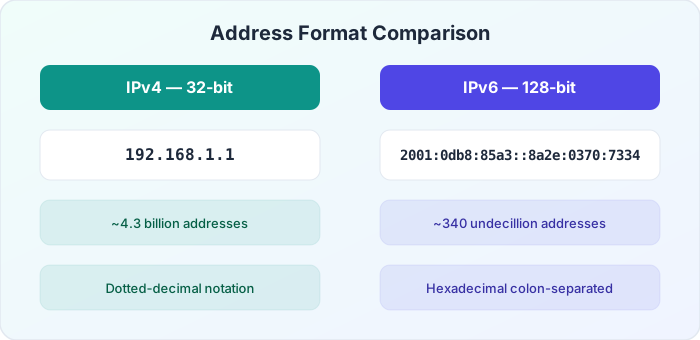
Quick Comparison
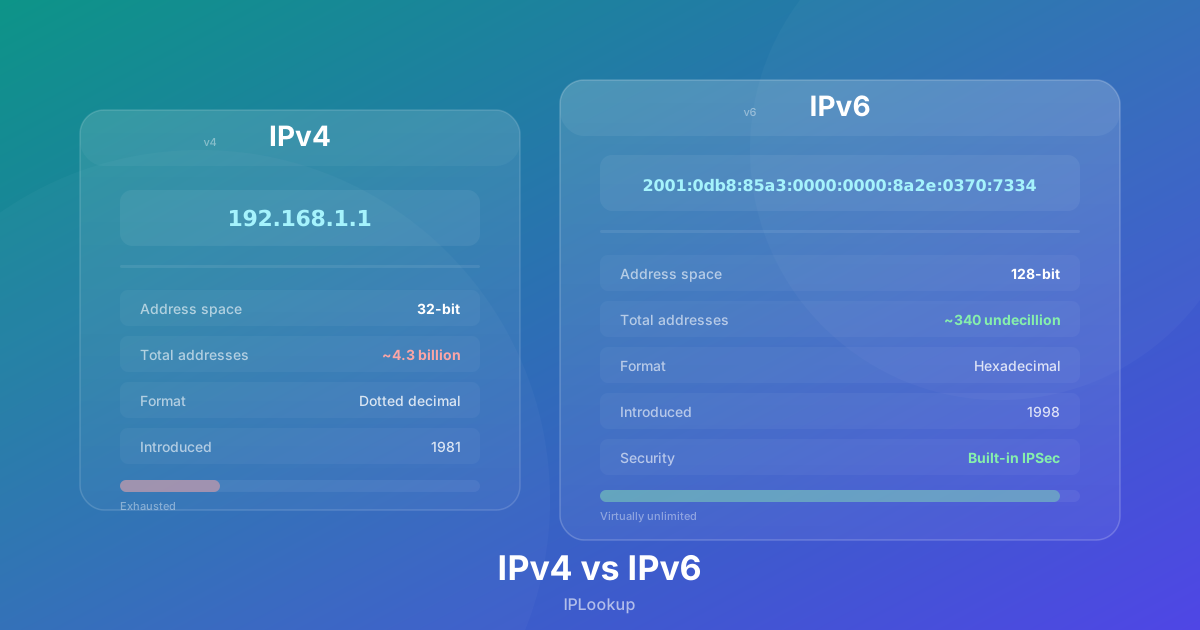
| Feature | IPv4 | IPv6 |
|---|---|---|
| Address size | 32-bit | 128-bit |
| Address format | Numeric dotted-decimal (e.g., 192.168.1.1) | Hexadecimal colon-separated (e.g., 2001:db8::1) |
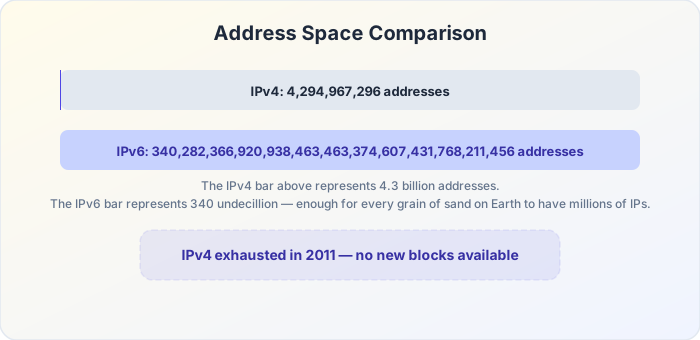
| Total addresses | ~4.3 billion | ~340 undecillion (2^128) |
| Security | Optional IPSec | Built-in IPSec support |
| NAT | Required for most networks | Not needed (enough addresses) |
| Configuration | Manual or DHCP | Stateless auto-configuration (SLAAC) |
| Packet fragmentation | By routers | By sender only |
What Is IPv4?
IPv4 was introduced in 1981. It’s the original workhorse of the internet, using a 32-bit address space for about 4.3 billion unique addresses. An IPv4 address looks like 192.168.1.1 — four decimal numbers separated by dots.
Here’s the thing: 4.3 billion seemed like more than enough in the 80s. Nobody anticipated smartphones, smart TVs, IoT sensors, or a world where every office printer needs its own IP. The IANA allocated the last remaining IPv4 blocks in 2011. We’ve been running on fumes ever since.
That scarcity created a weird side effect. IPv4 addresses became a literal asset class. A single address costs $30-50 on the secondary market. A /24 block (256 addresses) runs $7,000-13,000. There are companies whose entire business model is leasing their IPv4 blocks. Large organizations carry IPv4 inventories as balance sheet assets. I find this wild — we built an asset class out of a technical limitation.
IPv4 relies on NAT (Network Address Translation) to stretch its limited space. Multiple devices on a private network share a single public IP. It works, but it complicates peer-to-peer connections, online gaming, and self-hosted services. Ever tried hosting a game server from home? NAT is why it’s such a pain.
What Is IPv6?
If IPv4 feels cramped, IPv6 is the opposite extreme. Created in 1998 as a response to the address shortage, it uses a 128-bit address space — roughly 340 undecillion addresses. That’s 340 trillion trillion trillion. Enough to give every atom on Earth its own IP and still have plenty left. An IPv6 address looks like eight groups of hex characters separated by colons: 2001:0db8:85a3:0000:0000:8a2e:0370:7334.
More addresses is the headline, but IPv6 brings real improvements:
- Simplified header format — Fixed 40-byte header with fewer fields. Routers process packets faster. Cloudflare explains that IPv6’s streamlined header improves routing efficiency (source)
- No NAT required — Every device gets a globally unique, publicly routable address. Peer-to-peer apps, VoIP, online gaming, self-hosted services — all simpler without NAT in the way
- Built-in IPSec — Optional in IPv4, mandatory in IPv6. End-to-end encryption and authentication built into the protocol
- SLAAC — Stateless Address Auto-Configuration. Devices generate their own IPv6 addresses without a DHCP server
- More efficient routing — Hierarchical addressing shrinks routing tables
- No IP-layer checksum — Reduces processing overhead since TCP/UDP handle error checking anyway
Why Migrate?
Address exhaustion is the primary driver. Since 2011, ISPs and organizations have had to buy IPv4 on the secondary market at increasing prices. For a growing ISP in Asia or Africa, IPv4 addresses can cost more than the network equipment.
But the migration is slow. Most networks use dual-stack — running IPv4 and IPv6 simultaneously. Your browser tries IPv6 first, falls back to IPv4 if needed. You probably don’t notice.
Adoption keeps climbing. Google reports over 45% of their users access services over IPv6 as of 2026. Major ISPs in the US, Europe, and Asia offer IPv6 by default. Cloud providers (AWS, Google Cloud, Azure) and CDNs (Cloudflare, Akamai) all support it. Mobile networks are ahead of everyone — many cellular carriers have over 80% IPv6 adoption. Next time you load YouTube, there’s a good chance you’re on IPv6 without realizing it.
Privacy and Security Implications
This is the part most people don’t think about. IPv4 with NAT hides internal devices behind a single public IP. IPv6 eliminates NAT — every device potentially gets a globally unique, stable address that doesn’t change.
That’s a tracking nightmare. A website could identify your specific laptop across the internet without cookies or fingerprinting. IPv6 addresses this (pun intended) with privacy extensions (RFC 4941) that generate temporary, randomized addresses. Your device ends up with two IPv6 addresses: a stable one for incoming connections and a temporary one for outgoing.
On the security side, IPv6’s massive address space makes network scanning effectively impossible. Scanning a typical IPv4 /24 subnet (256 addresses) takes seconds. A typical IPv6 /64 subnet (18 quintillion addresses) would take centuries.
Which One Are You Using?
Visit our IP lookup page. Dotted-decimal like 203.0.113.1? That’s IPv4. Colons and hex characters like 2001:db8::1? You’re on IPv6.
Most users are still on IPv4. But if you see an IPv6 address, your ISP has already made the switch — and you’re experiencing the faster, more secure version of the internet.